Sometimes, an important scientific discovery begins with a careful observation on the shoreline.
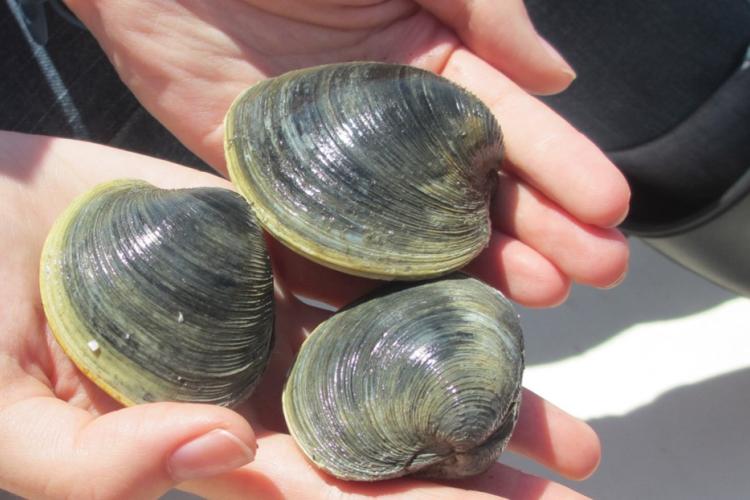
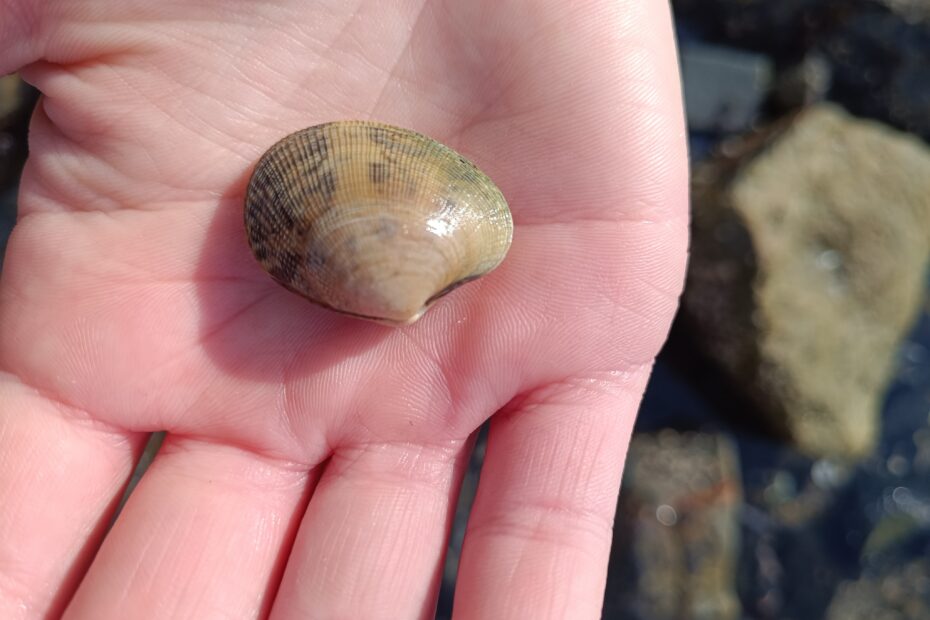
A newly published scientific paper documents the first confirmed established populations of the Manila clam (Ruditapes philippinarum) in the Northwest Atlantic. Led by Aly Putnam, PhD and a collaborative team of biologists from UMass Amherst and partner organizations, the study marks an important milestone in understanding how marine species are changing along the New England coast.
We’re especially proud because Salem Sound Coastwatch’s own Alison Frye is a co-author and SSCW volunteers contributed to the North Shore surveys that helped document this significant discovery.
The Manila clam, native to the Northwest Pacific, is one of the world’s most widely introduced shellfish species. Until now, it had not been confirmed as an established, reproducing species along the Atlantic coast of North America.
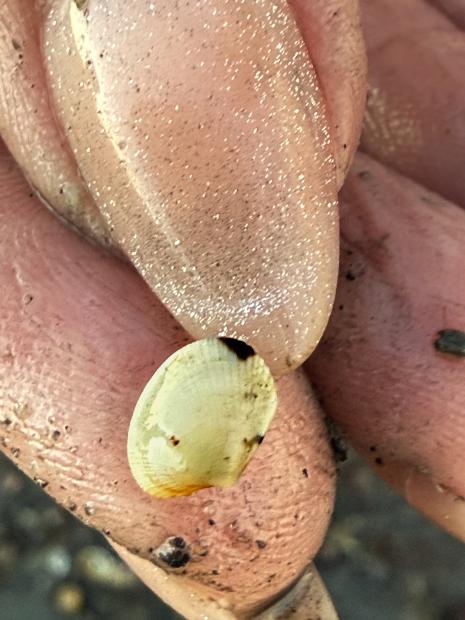
The discovery began with reports of “weird clams” around Provincetown in 2023. Then in 2025 text messages led to a deeper investigation across the Massachusetts coast. This included surveys by SSCW staff and volunteers who discovered live Manila clams at Lynch Park in Beverly. Follow-up surveys found additional live clams and shells, documenting what is currently the northernmost known occurrence of the species in the Northwest Atlantic.
The study highlights the power of collaboration. Researchers worked alongside nonprofits like SSCW, collaborative programs like MassBays, state agencies, iNaturalist users, and volunteers across Massachusetts to identify and document the species’ spread. The observations made by SSCW volunteers helped expand scientists’ understanding of the clam’s range and demonstrate how community science can play a critical role in the early detection of emerging marine species.
Scientists are still studying what the arrival of the Manila clam may mean for New England’s coastal ecosystems. Continued monitoring will help researchers better understand how the species spreads and whether it is a helpful, disruptive, or neutral addition to this coastal habitat.
We’re proud to congratulate Alison Frye on her contribution to this landmark publication and to recognize the leadership of Aly Putnam and the entire research team. This study is a wonderful reminder that meaningful scientific discoveries often begin with careful observations made by people who care deeply about their local coast, and that volunteers can play an important role in advancing science.
Completing the journey in the global north: the Manila clam (Ruditapes philippinarum) (Bivalvia: Veneridae) arrives in the Northwest Atlantic Ocean. AB Putnam, C Bastidas, OC Nichols, JC Clements, EF Hartshorn, DW Chin, A Frye, R Gagne, ML Geiger, R Hutchinson, et al. Biological Invasions 28 (7), 163