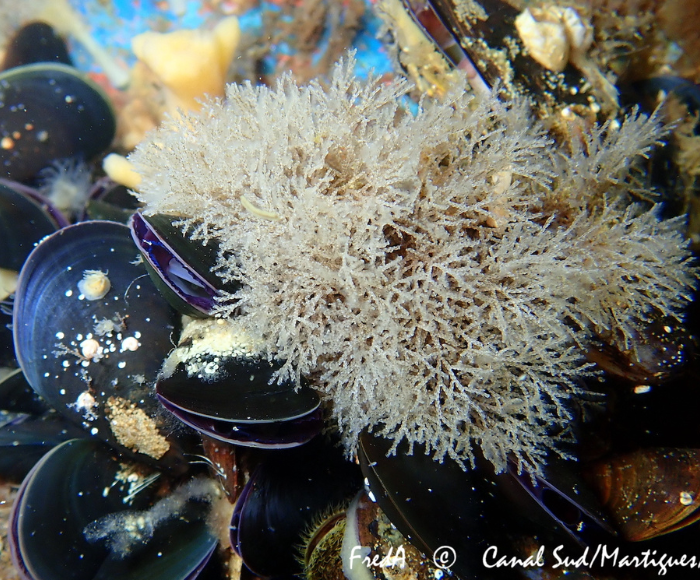
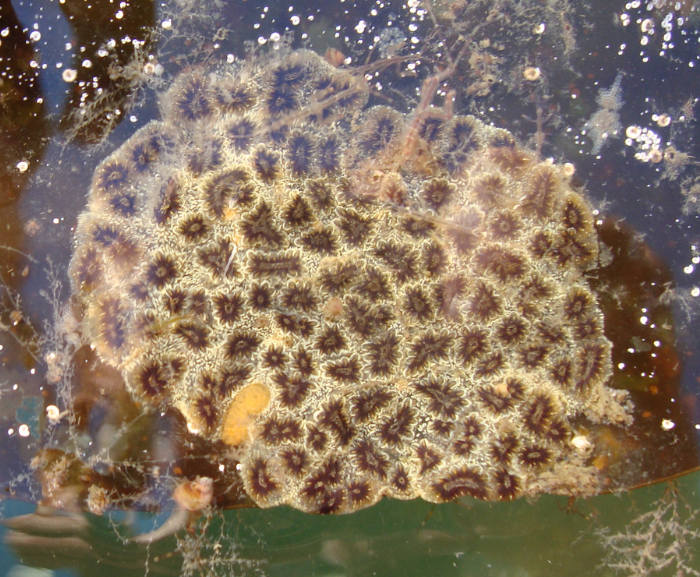
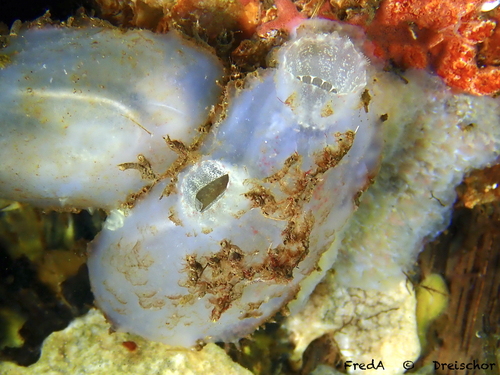
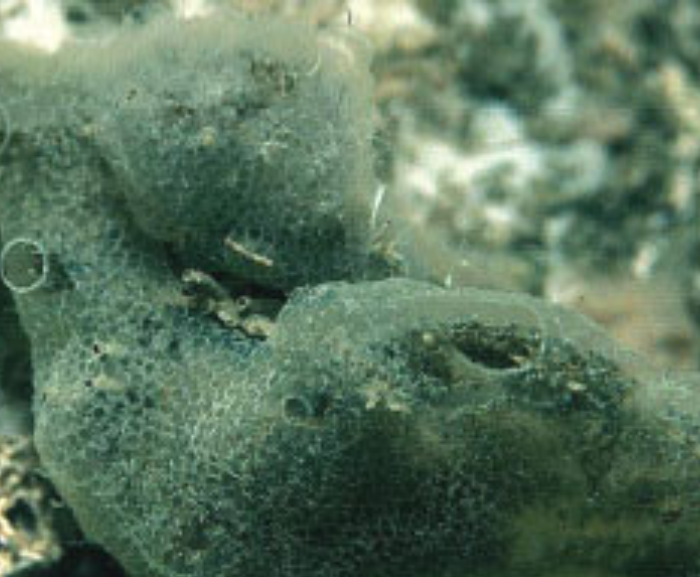
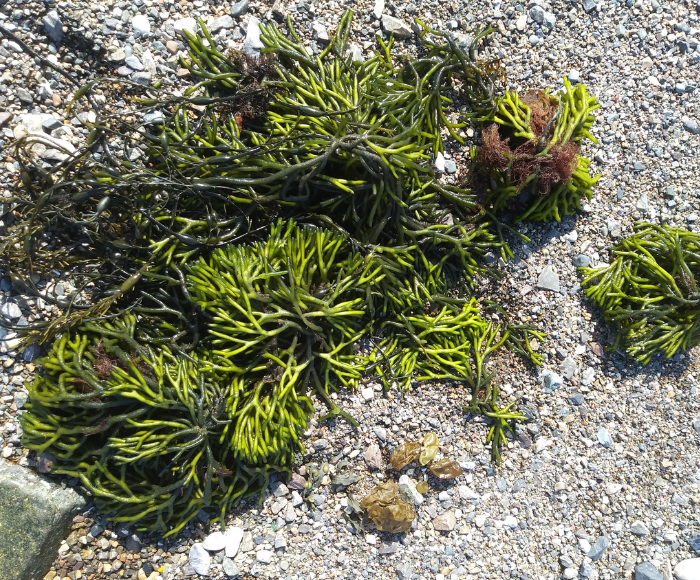
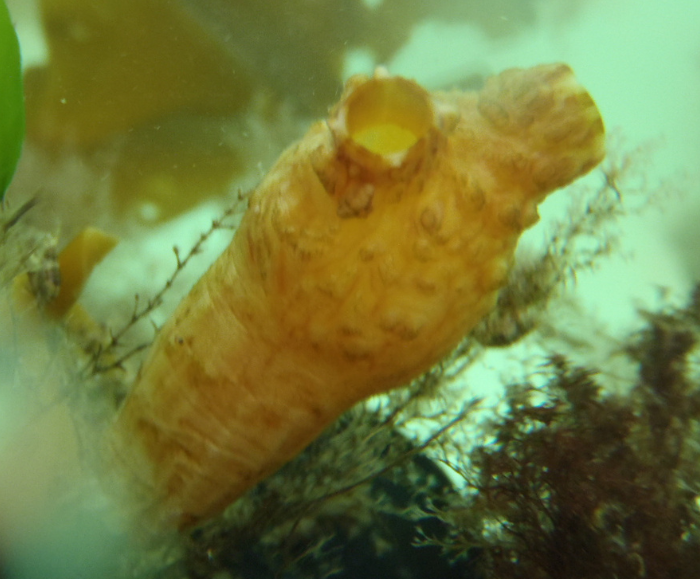
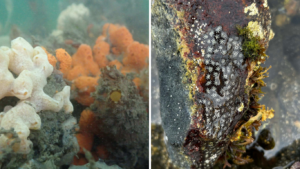
Unexpected bryozoans are cream or tan and can be identified by a “crunchy” feeling when squeezed. They are native to the Western Pacific and were first reported in Massachusetts in 2010. Observations of the unexpected bryozoan in Massachusetts indicate that it competes with native bryozoans, though other ecological impacts have not been identified.
Sheath Tunicate (Botrylloides violaceus)
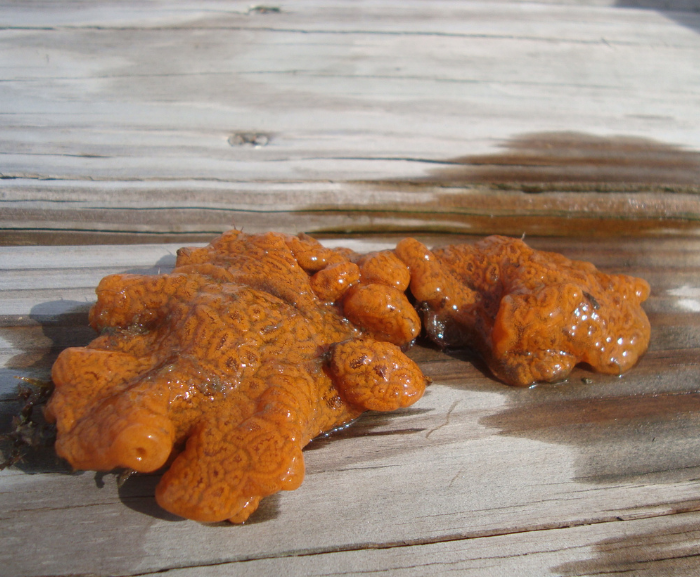
Sheath tunicates range in color, from bright orange, red, yellow, cream, and purple. In New England, the sheath tunicate was first reported in the 1980s, spreading from its native environment in the Northwest Pacific. It is a pervasive fouling organism that has displaced both native and invasive tunicates, as well as other fouling organisms, as they compete for space and food. Sheath tunicates are also known to adversely affect eelgrass, a species which is being restored in Salem Sound.
Sea Vase (Ciona intestinalis)
Photo by Dr. Keith Hiscock
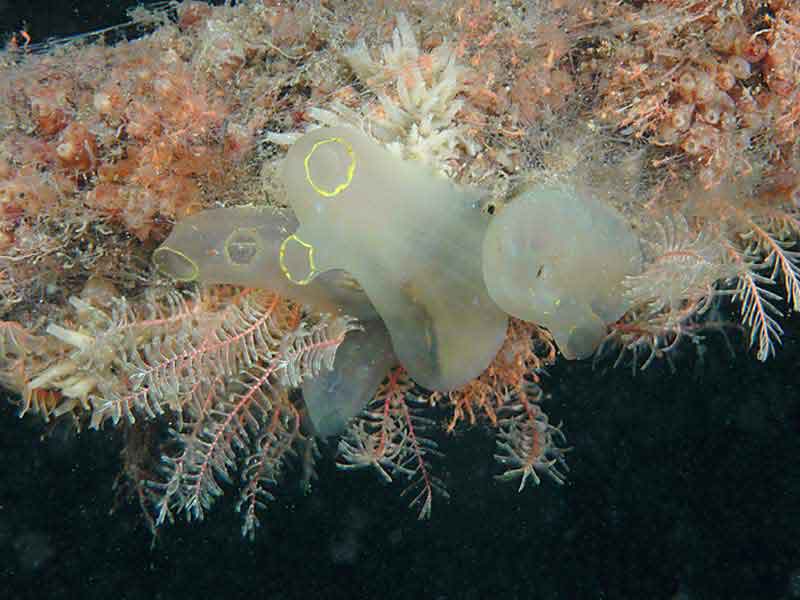
Sea vases are solitary tunicates that are transparent with some light, variable color and a ringed yellow siphon. Some evidence points to sea vases originating in Europe, though they were reported in Massachusetts beginning in the 1830s.
Sea Potato (Colpomenia peregrina)
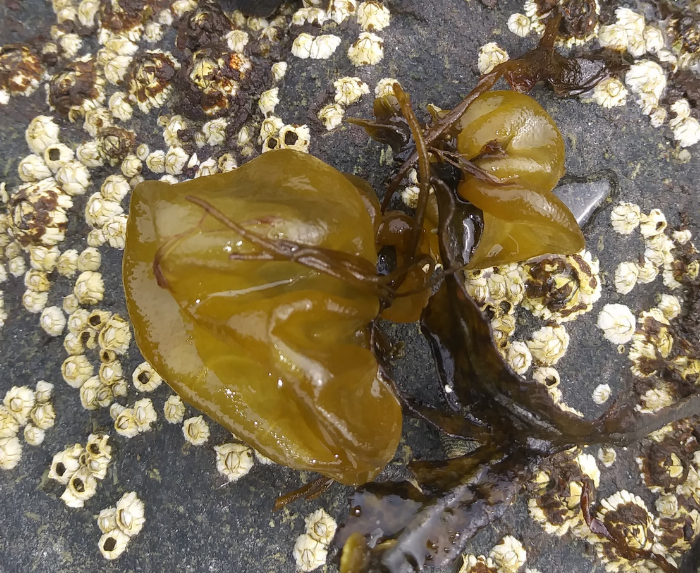
Sea potatoes are brown, bubble-shaped algae that can grow to be up to 4 inches wide. They are referred to as “oyster thieves” because when they fill with water, they can carry attached oysters away from beds. Though native to the Northwest Pacific, they were first reported in New England in the early 2010s. Its ecological impact on native species is currently under review, but it is considered as a pest to oyster fisheries and may be a competitor with native seaweeds.
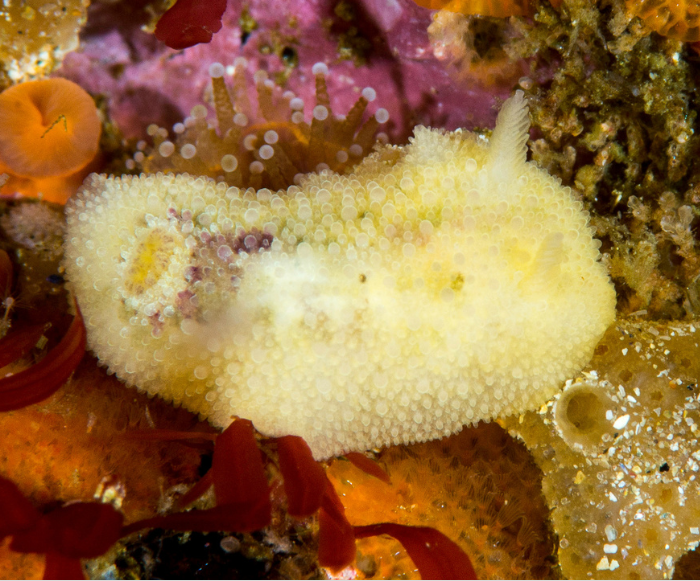
Sea Lemon Nudibranch (Doris pseudoargus)
The sea lemon nudibranch is named for its oval shape, bumpy texture, and variable yellow color. They can grow up to 4.5 inches long and were first reported in Massachusetts in 2017. Known to feed only on sponges, two species of which are found in the Gulf of Maine, this nudibranch could have impacts on sponge communities.
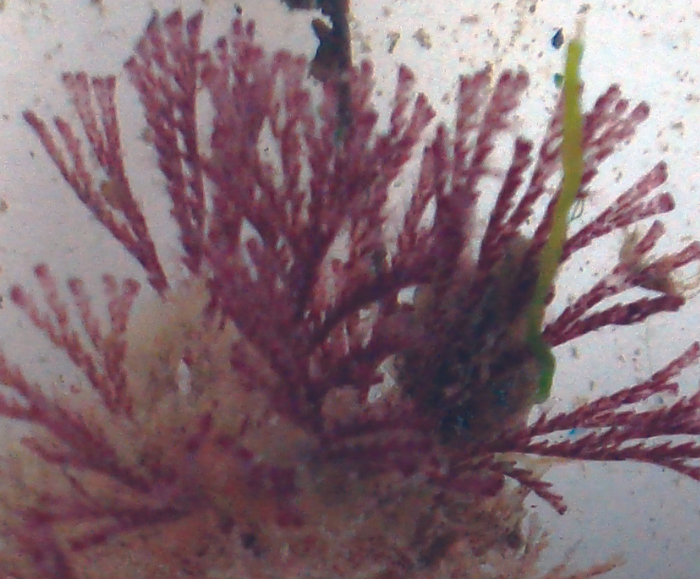
Purple Bushy Bryozoan (Bugula neritina)
The native range of purple bushy bryozoan is unresolved, but it was first collected in Massachusetts in the late 1800s. It is soft to the touch, and ranges in color from deep purple to brownish red. Purple bushy bryozoan is a fouling organism that can be found on fixed structures and aquaculture nets and cages. This species of bryozoan is tolerant to copper-based antifouling paints, which may give it a competitive edge over other fouling species. Additionally, the purple bushy bryozoan has been observed to have higher survival rates in above average temperatures compared to native tunicates.
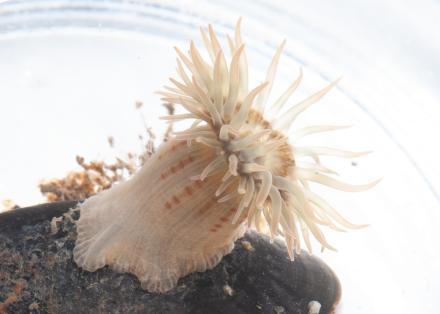
The pink-spotted anemone is known as a range-expanding species, as its range has moved northward in the Atlantic due to climate change. It has not been observed in New England outside of Rhode Island, where it was reported in 2010.
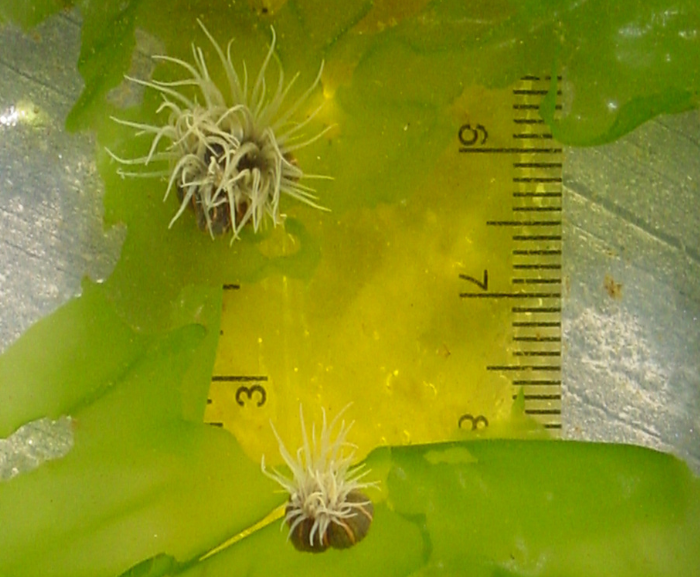
Orange-Striped Anemone (Didadumene lineata)
Orange-striped anemones often grow in clusters close to the surface of the water, attaching to rocks, docks, and vegetation. Their body column is green to brown with vertical orange, white, or tan stripes. Native to the Northwest Pacific, orange-striped anemones were first reported in New England in the late 1800s. Despite its status as a marine invader, there are no reported ecological impacts in its non-native range.
Pancake Batter Tunicate (Didemnum vexillum)
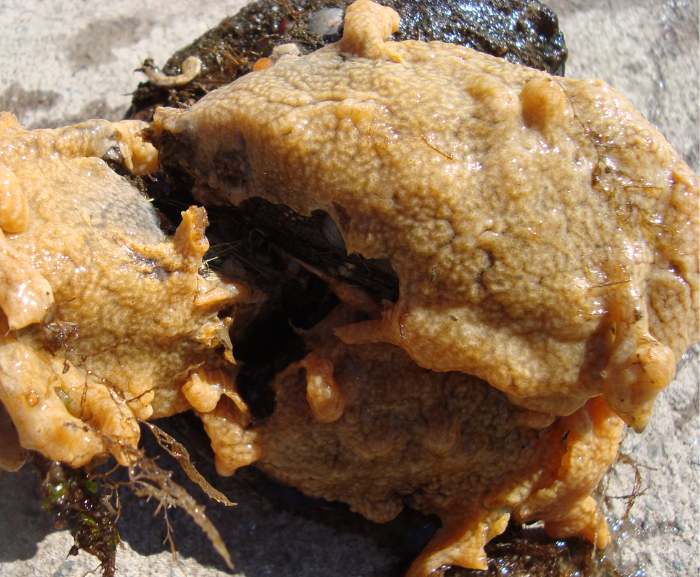
Pancake batter tunicate is named for its distinctive tan to orange appearance, which can often form long tendrils resembling drips of pancake batter. It is a rapidly spreading tunicate that can inundate shellfish, algae, rocks, and other sessile organisms. It was first reported in New England in the late 1990s, though it is native to the Northwest Pacific. This tunicate is a significant threat to benthic species due to its aggressive nature which allows it to dominate competition for resources and smother native species.
Lacy Crust Bryozoan (Membranipora membranacea)
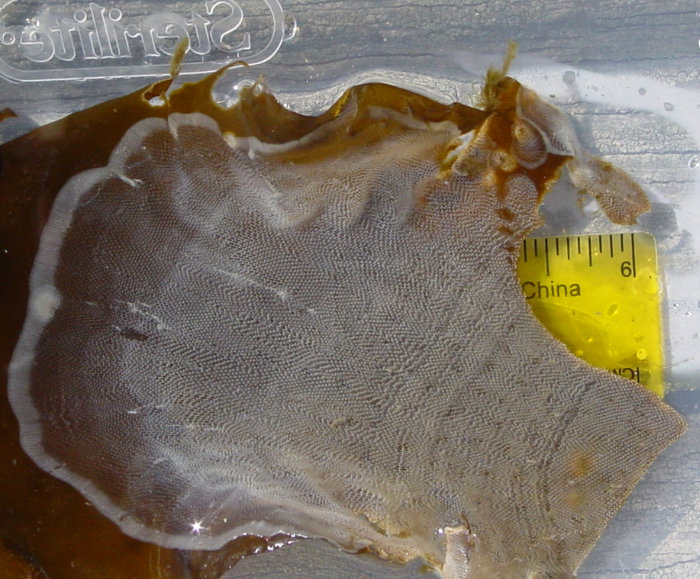
The lacy crust bryozoan is an encrusting white or light-gray bryozoan that forms a lace-like layer on native kelp. In doing so, it shades and weakens seaweeds, making them more susceptible to tearing and breaking. Lacy crust bryozoans often overgrow native bryozoan species and reduce available fish habitat in kelp beds. Lacy crust bryozoan is native to European waters but was first reported in New England in 1987.
Pacific Skeleton Shrimp (Caprella mutica)
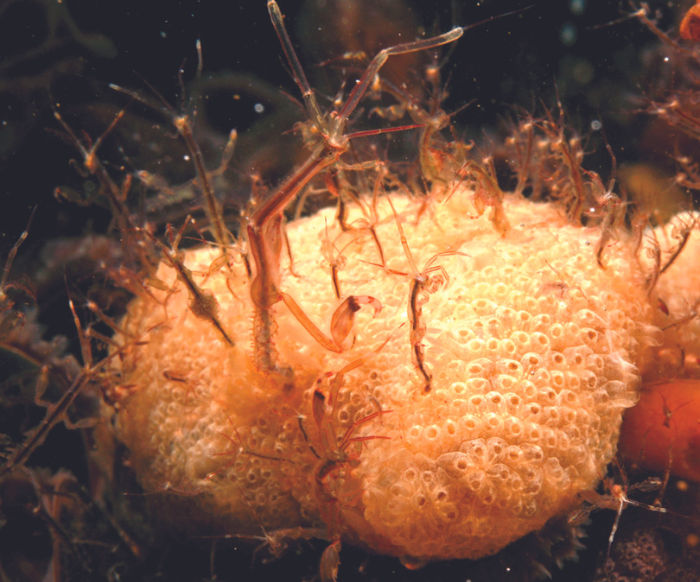
Pacific skeleton shrimp are mottled red with small spines along the back half of their bodies. They’re native to the Northwest Pacific but were first reported in New England in 2000. Known ecological impacts of skeleton shrimp are limited, however some observations suggest that they can displace native species, affect the feeding of native fishes, and interfere with aquaculture, specifically pertaining to mussels.
Devil's Tongue Weed (Grateloupia turuturu)
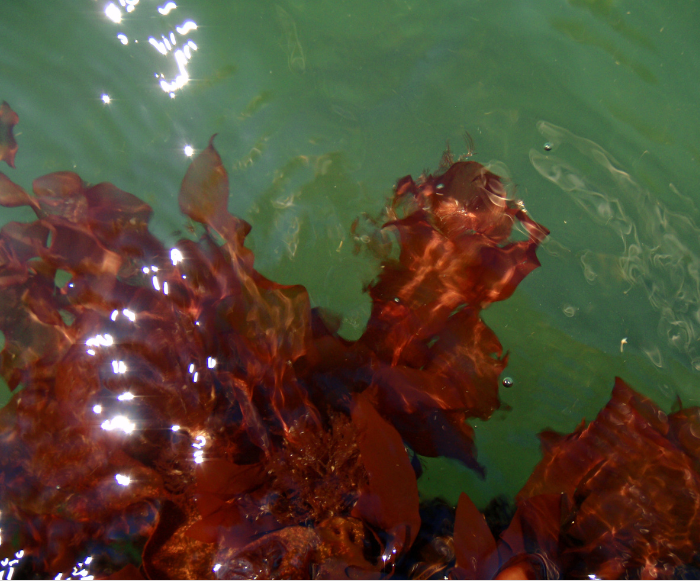
Devil’s tongue weed is pink, red, or reddish brown and is one of the largest known red algae. It is characterized by a distinctly slippery texture. Devil’s tongue weed is native to the Northwest Pacific but was first reported in New England in the 1990s. On the East Coast, Devil’s tongue weed was observed to support fewer invertebrates and epiphytes than native red algae.
Golden Star Tunicate (Botryllus schlosseri)
Despite its name, the golden star tunicate can range in color from blue-black, green, violet, brown, red, orange, and yellow. It is distinguishable by the appearance of star-like clusters. Its origin is unknown, but it was first recorded in Boston in the 1830s. The golden star tunicate is an abundant fouling organism, who competes for space with native species and poses a threat particularly to native eelgrass.
Rockpool Shrimp (Palaemon elegans)
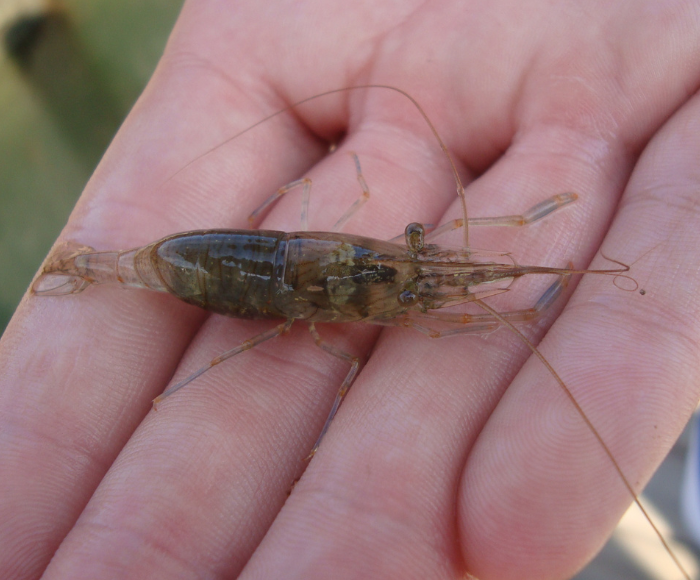
Rockpool shrimp are mostly translucent, with neon blue rings are their claws, dark red bands on their body, and orange or blue bands on their legs. Native to the Northeast Atlantic, they were first reported in Salem in 2010. Rockpool shrimp may displace native species, though other ecological impacts have not been reported.
Flat Oyster (Ostrea edulis)
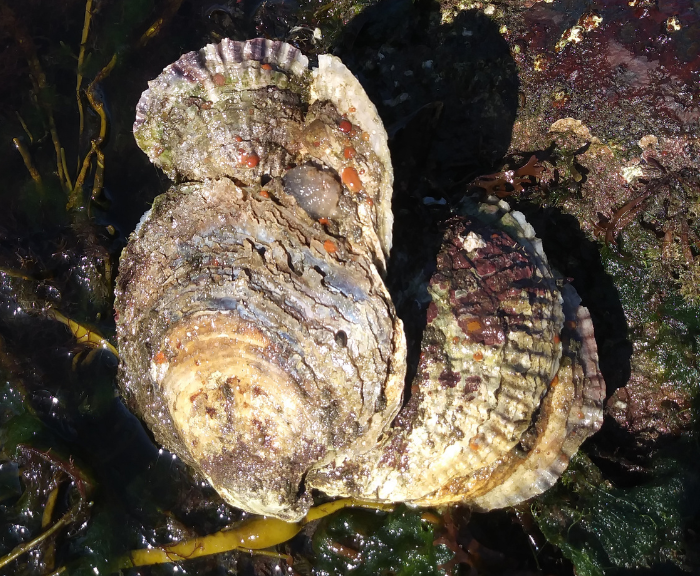
The flat oyster is native to the Northeast Atlantic, the Mediterranean Sea, and the Black Sea. They were first introduced to New England in the mid-1900s. Though the flat oyster does not have any reported impacts on native species, they are subject to many diseases and are regarded as difficult to raise due to periodic die-offs related to parasites.
European Green Crab (Carinus maenas)
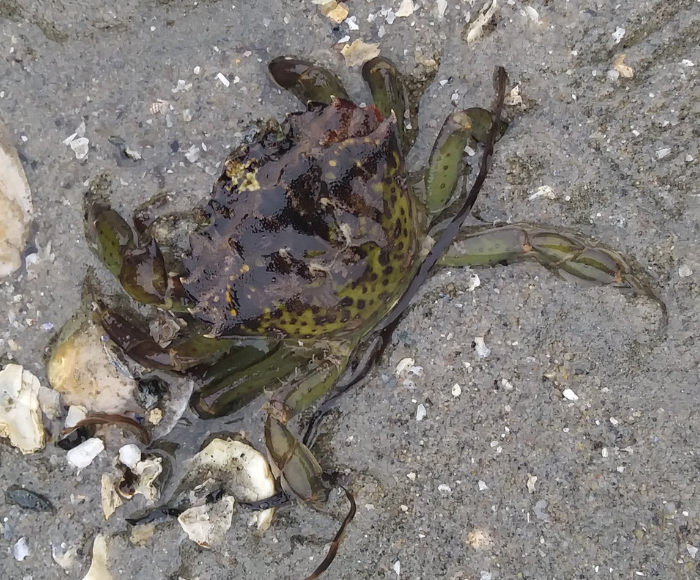
Native to the Northeast Atlantic, the green crab has been introduced multiple times to New England, with initial reports dating to the mid-1800s. Green crabs are typically dark green to green-yellow and have 5 spines on both sides with 3 between their eyes. Historically, green crabs have threatened soft-shell clams, quahog clams, and other shellfish populations in New England.
European Sea Squirt (Ascidiella aspersa)
Photo by Daniel Rodrigues
First reported in New England in the early 1980s, this sea squirt is native to the Northeast Atlantic. They are thin, semi-translucent, with a bumpy surface. In its invaded range, the European sea squirt competes with native species for space and has been reported to foul aquaculture gear.
Jelly Crust Tunicate (Diplosoma listerianum)
The jelly crust tunicate was first reported in New England in the 1990s, but its native range remains unresolved. It is a milky, grayish tunicate that can feel slimy to the touch. By forming encrusting sheets, the jelly crust tunicate fouls shellfish, seagrasses, crab shells, and other sessile organisms.
Green Fleece (Codium fragile)
Bright green, spongy seaweed that attaches to surfaces in tidepools and shallow coastal waters. Originally found in the Northwest Pacific, green fleece was first reported in the Long Island Sound in the 1950s. Green fleece is responsible for smothering many commercially fished species as it fouls shellfish beds by attaching to their shells.
Club Tunicate (Styela clava)
Native to the Northwest Pacific, club tunicate was first reported in Beverly in 1970. They are characterized by a long, club-shaped body that is mottled and brown. Dense populations of club tunicate foul aquaculture gear and compete with native species for space.
Banded Shore Crab (Hemigrapsus sanguineus)
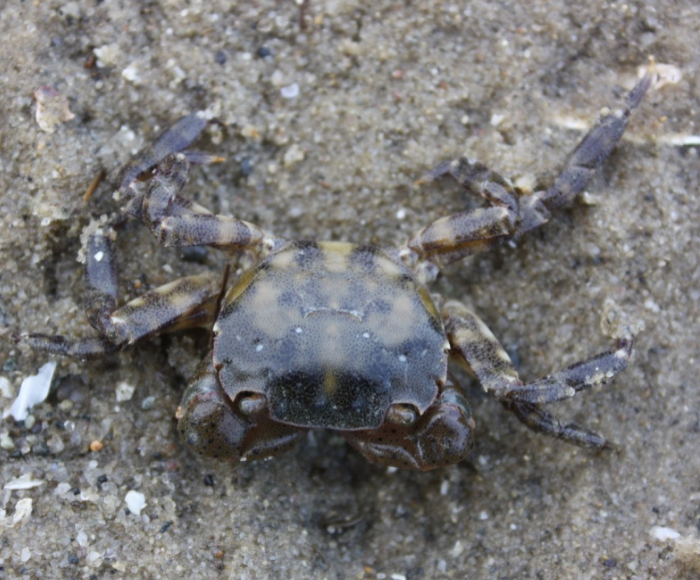
These crabs are orange-brown, olive green, maroon, or purple, with bands on their legs. They have 3 spines on each side, with none between their eyes. Though native to the Northwest Pacific, they were first reported in the 1990s. The presence of banded shore crabs has led to a decline in the abundance of green crabs, an increase in predation rates, and competition for habitat.
Bluefish (Pomatomus saltatrix)
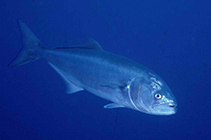
Also known as tailor or snapper elves, blue fish are blue and silver fish with very sharp teeth. Bluefish are schooling fish who feed on the surface of schools of bait fish. Despite their predatorial nature, bluefish are hunted by tuna, sharks, seals, and porpoises. In Massachusetts, bluefish inhabit inshore water from spring to fall before migrating south and offshore in the cooler months.
Lion's Mane Jellyfish (Cyanea capillata)
Photo by John Tlumacki
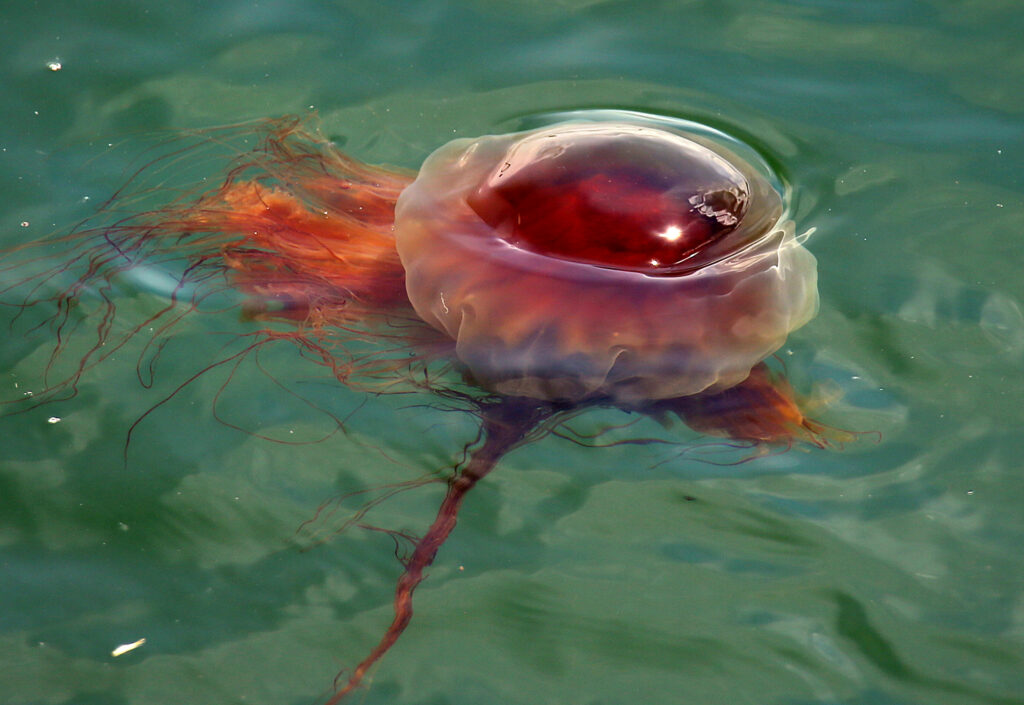
Lion’s mane jellyfish are one of the largest varieties of jellyfish, named for its long mane of brown to reddish tentacles that can reach up to 3m in length. The nematocysts on the lion’s mane jelly are especially powerful and are used to help catch its prey—though its sting can be painful to humans as well! Lion’s mane jellies are also continual swimmers and, when aided by favorable currents, can travel significant distances.
Atlantic Striped Bass (Morone saxatilis)
Photo by Alex Shure
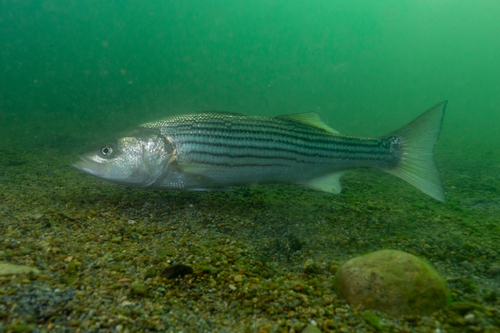
The Atlantic striped bass is identifiable by its seven to eight horizontal stripes. They can grow up to 5 feet in length, with females generally growing larger than males. Though many Atlantic striped bass live in the ocean, migrating north and south seasonally,they return to freshwater in the spring to spawn.
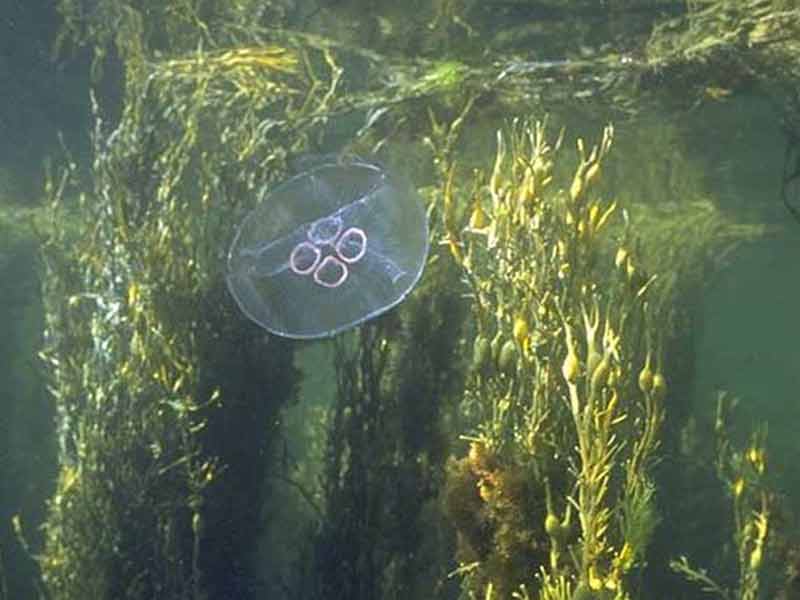
Common Moon Jellyfish (Aurelia aurita)
Photo by Sue Scott
Moon jellyfisharealmost entirely translucent and feed on medusae, plankton, and mollusks. While they do have short tentacles, their sting has little to no effect on humans as their nematocysts—their stinging cells—are too weak to affect human skin.
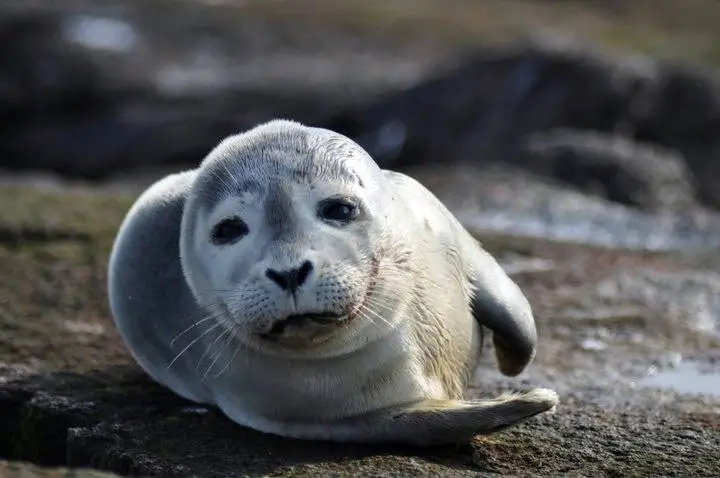
Harbor Seal (Phoca vitulina)
Photo by Amanda Boyd
Also known as the common seal, harbor seals are the most widely distributed pinniped species. When they are not traveling or foraging, harbor seals rest on rocks and beaches to regulate their body temperature, care for their pups, and interact with other seals. They also haul out of the water to avoid predators. In addition to natural predators, harbor seals are threatened by human actions, including habitat degradation, contamination, vessel collisions, and marine entanglement.
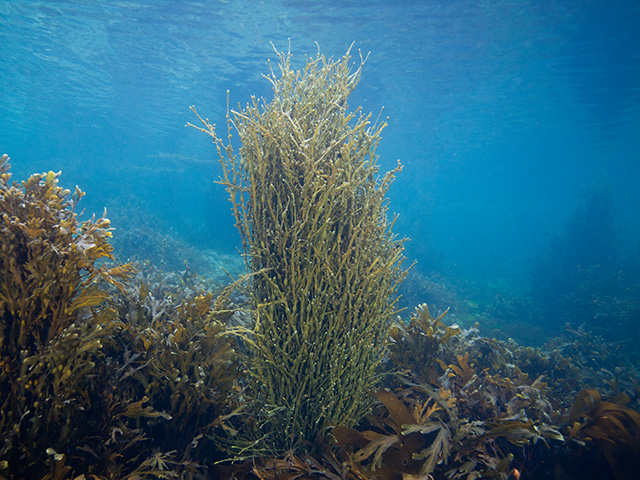
Rockweed (Ascophyllum nodosum)
Photo by Kare Telnes
Rockweed is a species of brown algae that grows on hard surfaces, including dock pilings, rocks, and shells. In addition to providing sheltered habitat and serving as a food source for other species, rockweed also helps to regulate dissolved CO2. This process assists in managing water quality.
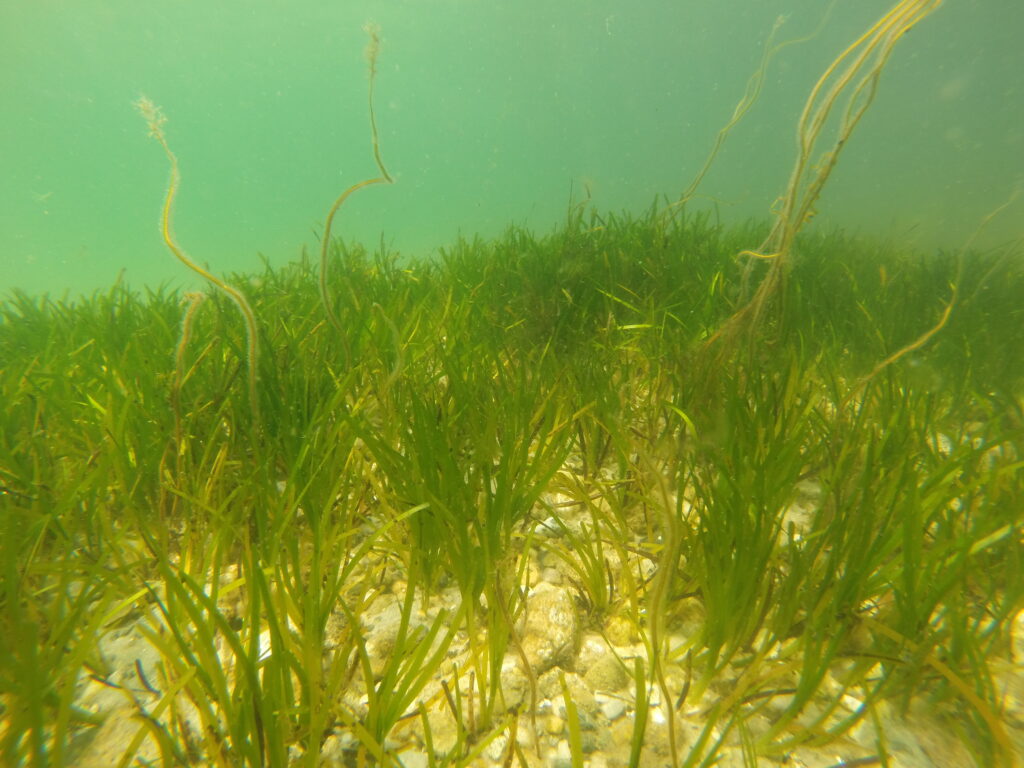
Eelgrass (Zostera marina)
Eelgrass provides a range of ecosystem functions, including improving water quality, storing carbon, preventing erosion, and providing habitat and shelter for other marine life. Degradation to eelgrass beds has primarily occurred due to development, dredging, and pollution, but efforts are currently being undertaken to restore eelgrass populations to Salem Sound.
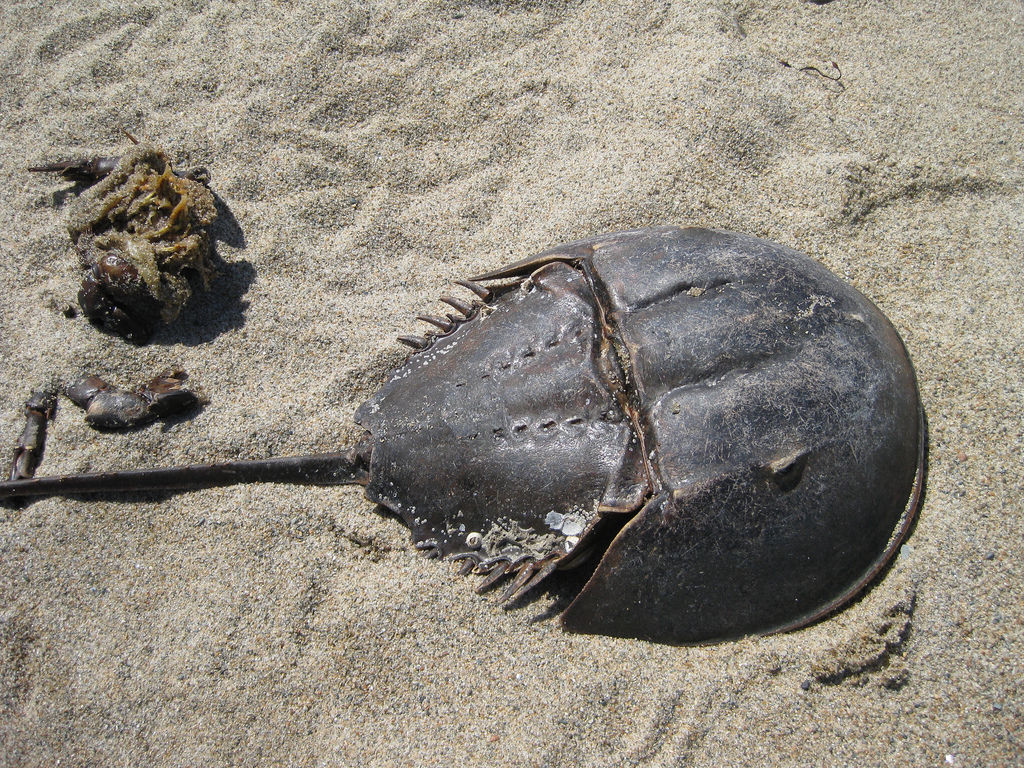
Atlantic Horseshoe Crab (Limulus polyphemus)
Photo by Tracy Barbaro
Despite their name, horseshoe crabs are not actually crabs! They are actually arthropods and are more closely related to spiders or scorpions. Horseshoe crabs have a range of suitable habitats depending on what point they are in their life cycle, with mature adults generally residing up to the edge of the continental shelf unless mating. Horseshoe crabs are also known for their use in the biomedical industry, as their blood is used to test equipment and supplies for bacteria. Likewise, the species is regarded to be particularly vulnerable to climate change regarding temperature, acidification, and sea-level rise.
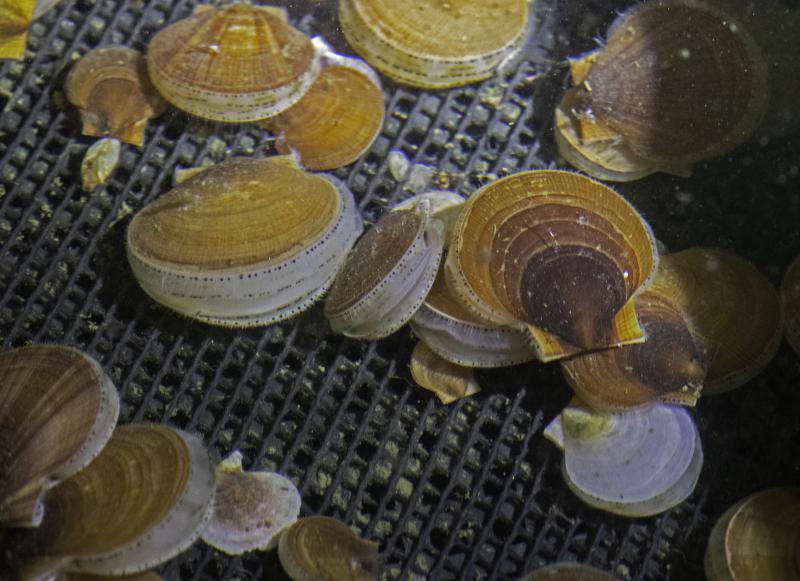
Atlantic Sea Scallop (Placopecten magellanicus)
Photo by NOAA Fisheries
Atlantic sea scallops are generally found at depths of 18 to 110 m and often aggregate in beds on firm sand, rock, and shells. They are one of the most commercially important fishery species, with Massachusetts being one of the primary harvesters. Scallops feed on phytoplankton and small organisms, helping to improve water quality through filtration.
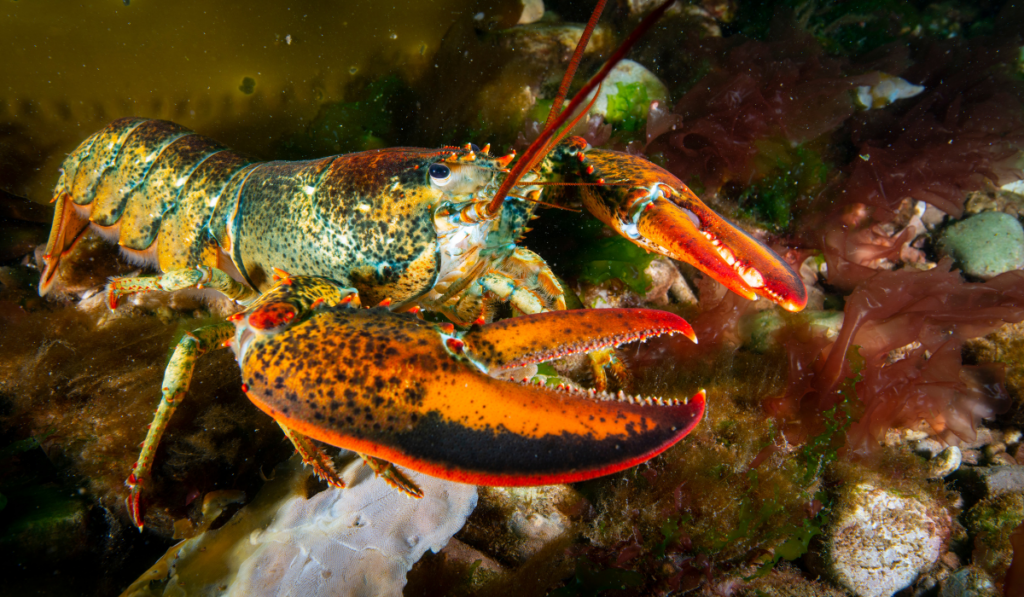
American Lobster (Homarus americanus)
Photo by Oceana
The American lobster is the largest species of lobster which lives on the sea floor in habitats that provide shelter such as seagrass beds, reefs, and mud. These lobsters support some of the most valuable fisheries on the Atlantic coast,however their population faces challenges due to environmental changes, particularly regarding temperature.
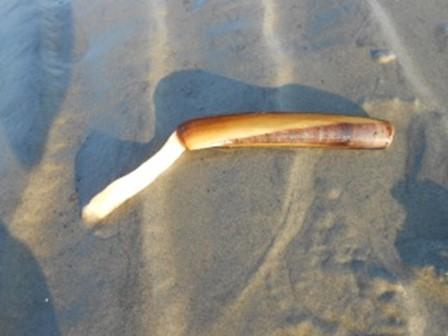
Razor Clam (Ensis leei)
Photo by David S. Johnson
The razor clam is easy to identify due to its long thin shell. This shape paired with their strong muscular foot makes the razor clam an especially mobile bivalve species who can burrow very deep into the sand. The motion used to burrow also allows razor clams to swim or jump through the water to escape from predators, or to find more suitable conditions. Despite their mobility, razor clams often inhabit nearshore areas, which makes them susceptible to pollutant contamination.
Northern Moon Snail (Euspira heros)
Photo by Alex Shure
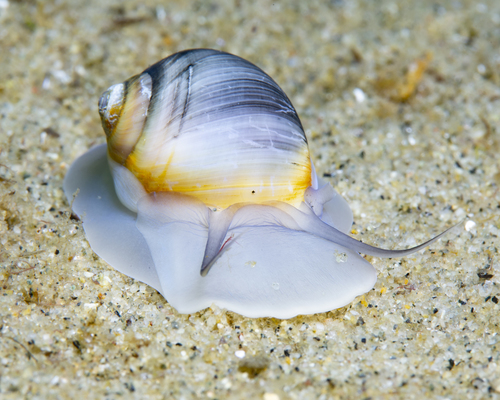
Moon snails are highly predatory snails who can grow to about 10 cm long and who are identifiable by smooth shells marked with a whorl. They are known to hunt slower mollusks, drilling a round hole into the shell of their prey. When moon snails reproduce, females burrow beneath the surface of the sand, coats her foot in a layer of mucus to bind together the sand and eggs, and leaves behind a “sand collar” which can sometimes be spotted on the beach.
Northern Quahog (Mercenaria mercenaria)
Photo by Julie Rose
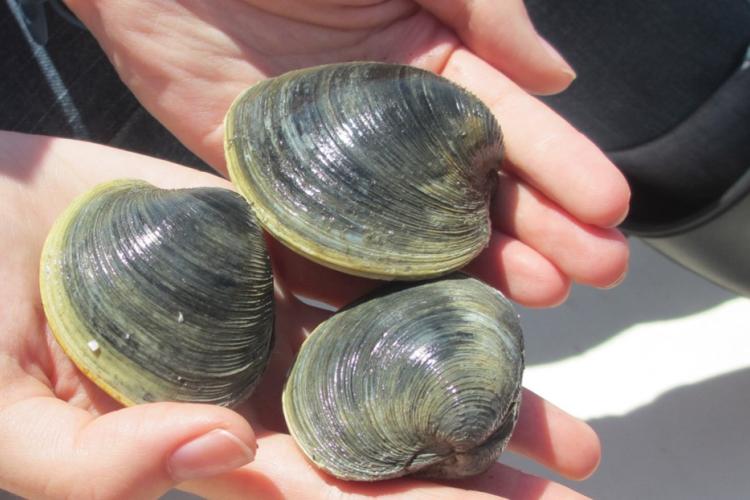
The quahog is a hard-shelled clam found along the coast from Canada to Florida who has a rich historical connection with Indigenous coastal communities. Today, quahogs are harvested both commercially and recreationally for the fishing industry, though they can only support low levels of fishing. Like other bivalves, quahogs are filter-feeders who remove excess nutrients and improve water quality.
American Oystercatchers (Haematopus palliatus)
Photo by Rob Sabatini
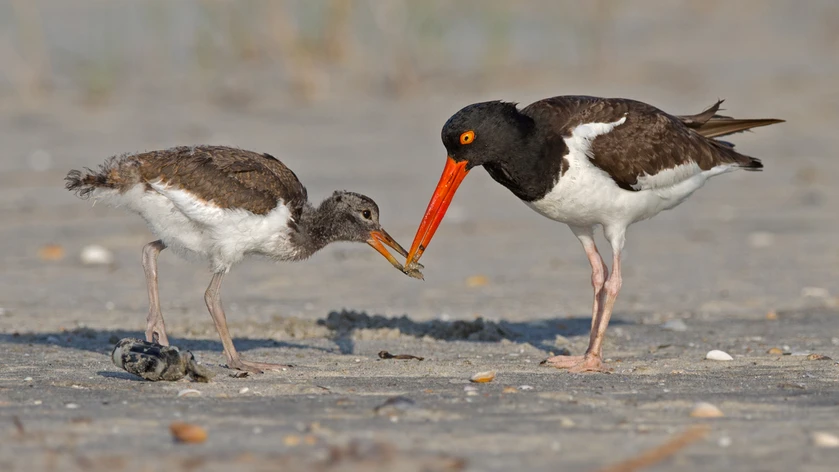
The American oystercatcher is a large shorebird who feeds on marine invertebrates. While they are not a common species along Massachusetts’ coasts, their population is increasing as their habitat range expands due to climate change and habitat availability, though is also speculated that these shorebirds are re-occupying habitat lost during European colonization rather than newly expanding their range. Like many other coastal birds, the American oystercatcher is threatened by habitat loss due to climate change and development, and has been designated as a Species of High Conservation Concern.
Piping Plover (Charadrius melodus)
Photo by Lorraine Minns
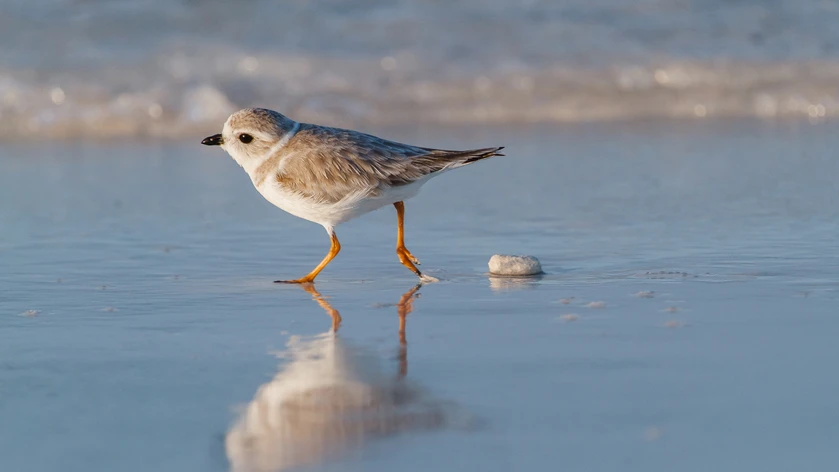
Massachusetts is a breeding hub for these iconic birds who are threatened both federally and statewide. Nesting on beaches and dunes, they experience threats due to development, human disturbances, predators, and stormtides, all of which decrease suitable habitat or curtail breeding success. Though the piping plover is protected under the Endangered Species Act, rising sea-levels and storm events driven by climate change continue to be a threat to plover populations.
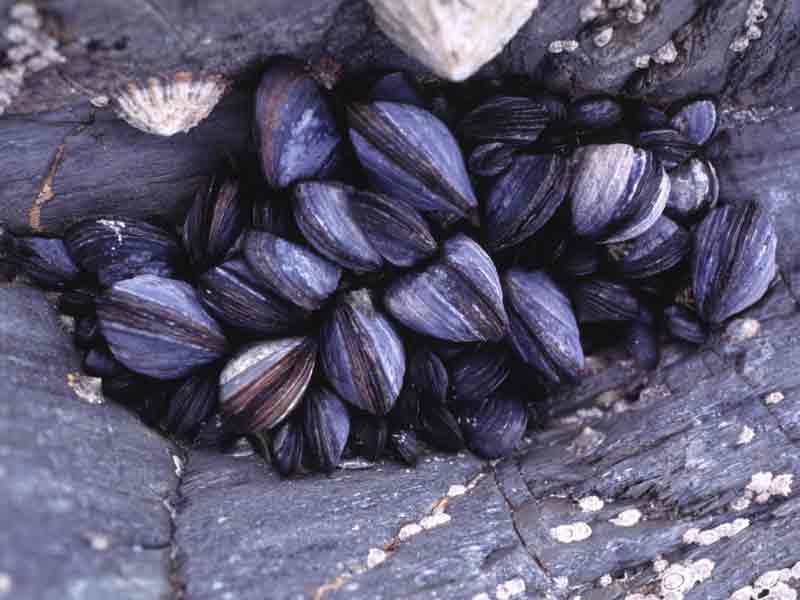
Blue Mussel (Mytilus edulis)
Photo by Dr. Keith Hiscock
The blue mussel often grows on docks, buoys, and pilings throughout New England. Blue mussel shells are teardrop shaped, and range in colors from black, dark blue, and brown. Mussels are an important species for maintaining water quality as they remove excess nutrients from the water,however they are also likely to be impacted by ocean acidification due to climate change.
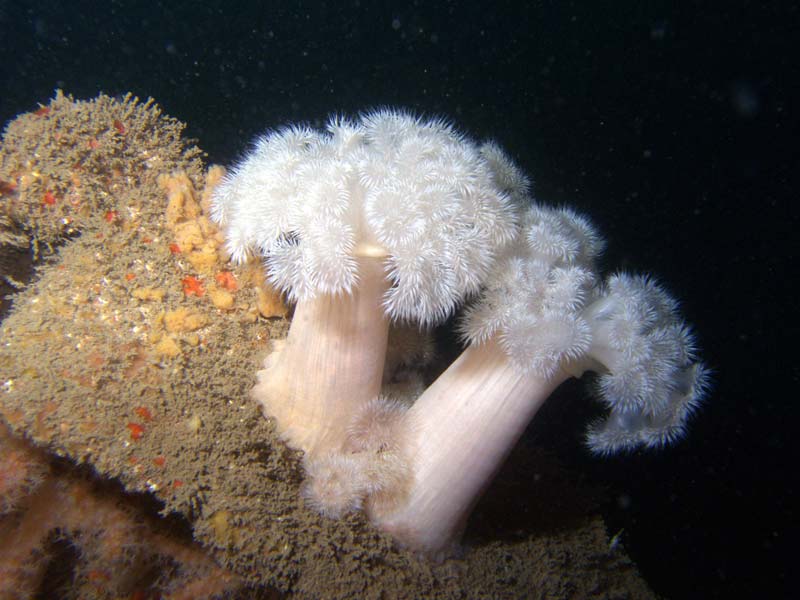
Plumose Anemone (Metridium senile)
Photo by Paul Newland
Also referred to as “fluffy” or “frilled” anemones, this species is found throughout New England, attached to hard surfaces. M. senile catches small organisms floating past, consuming copepods and various larvae. This type of sea anemone is also a protandric hermaphrodite, meaning it begins its life as a male and changes to female as it matures.
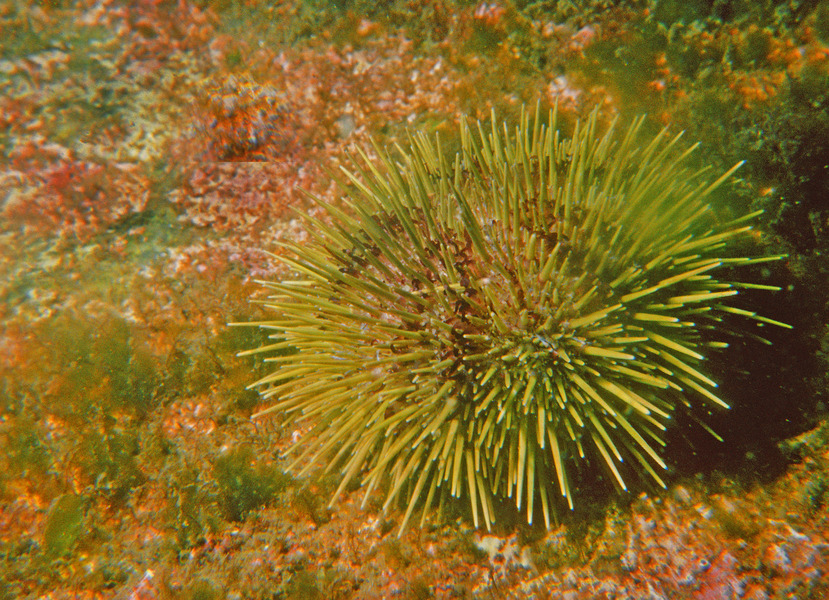
Green Sea Urchin (Strongylocentrotus droebachiensis)
Photo by Robert Bachand
Green sea urchins are named for their green outer shell and usually do not grow larger than 8cm. Spines on their exoskeletons help to protect against predators, such as crustaceans, seagulls, and certain fish. Generally, urchins hunt at night for algae, marine worms, and kelp, so you’re unlikely to see them out in the daylight!
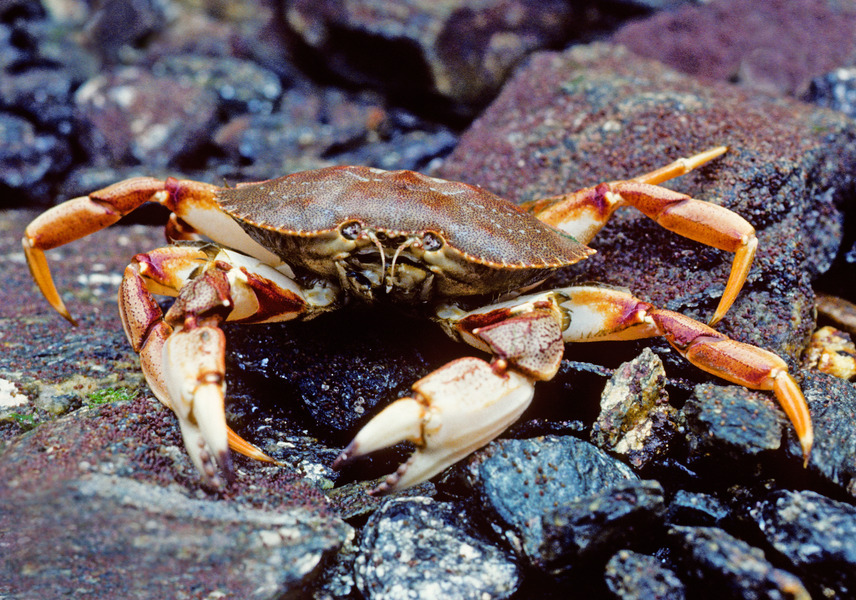
Atlantic Rock Crab (Cancer irroratus)
Photo by Robert Bachand
Atlantic rock crabs are native to New England and can be identified by their reddish-brown to light purple color, as well as the presence of nine smooth spines. Rock crabs are known as opportunistic feeders, eating an assortment of food sources depending on what’savailableto them. This can include algae, mussels, and other crustaceans. While at one point, rock crabs were seen as a nuisance to fishers—entering lobster traps and stealing bait—there is now a growing industry for rock crab fishing.
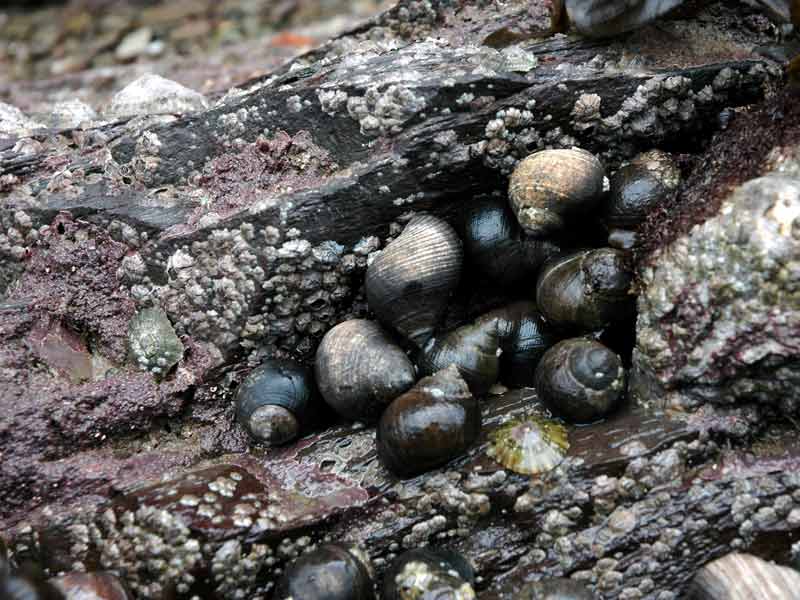
Periwinkles (Littorina littorea)
Photo by Dr. Keith Hiscock
Though you may see periwinkle snails across the coast, they areactuallya non-native invasive species in Salem Sound, originally found in Western Europe. They feed on a range of algaeand are able to hold water inside their shells to survive when the tide is out, though they are more active when submerged.
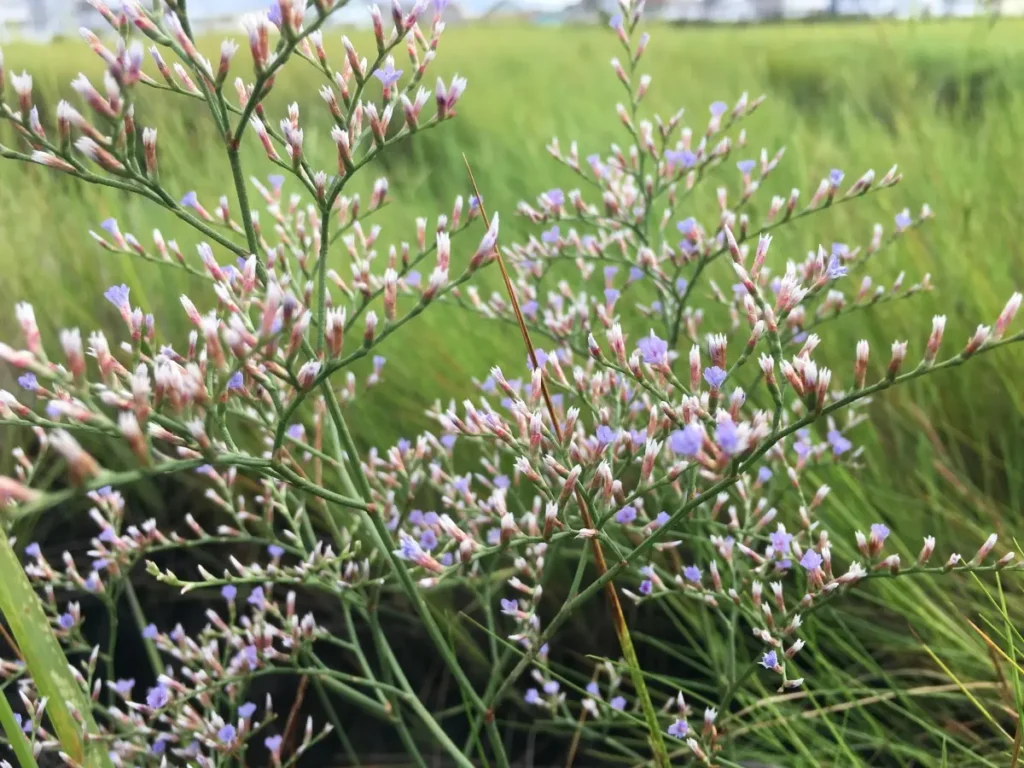
Carolina Sea Lavender (Limonium carolinianum)
Photo by Y. Laskaris/USFWS
Sea lavender is a saltmarsh plant that grows up to 2 ft high and is characterized by small, purple flowers. It is a slow-growing marsh plant, so populations can be depleted quickly when harvested.Sea lavender is fairly widespread throughout Massachusetts but could face threats due to climate change.
Mummichog Killifish (Fundulus heteroclitus)
Photo by Will Parson
Commonly referred to as “minnows,” mummichog killifish are small, silvery fish that live in marshes, tidal creeks, and a few yards offshore who often form large schools. Mummichog killifish feed on a range of marine plants, as well as small crustaceans, fish, and carrion.They’re also an important species for salt marsh food chains, as many larger marine species feed on them.
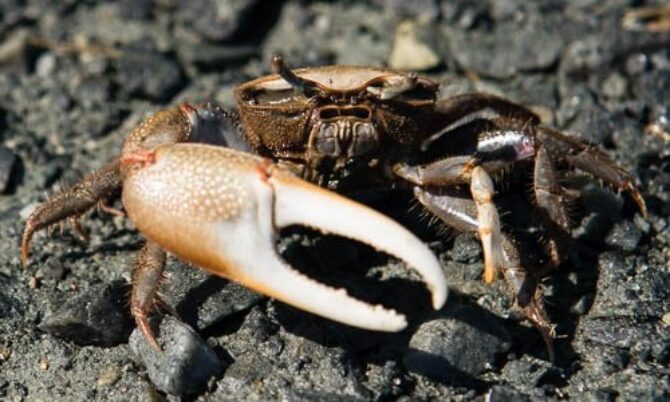
Atlantic Marsh Fiddler Crab (Minuca pugnax)
Photo by Will Parson
Though fiddler crabs have historically lived south of Cape Cod, their range has expanded further north in New England due to warming waters. These crabs build burrows in the marsh and are named for their distinctively large claw found on male crabs.While fiddler crabs have previously been thought to have a positive effect on marshes by encouraging plant growth, north of Cape Cod, this has not been the case. In fact, one study found that fiddler crabs damage plants’ roots as they’ve not yet adapted to burrowing animals, thus resulting in a drop in grass biomass.
Eastern Oyster (Crassostrea virginica)
Photo by Scott Rikard
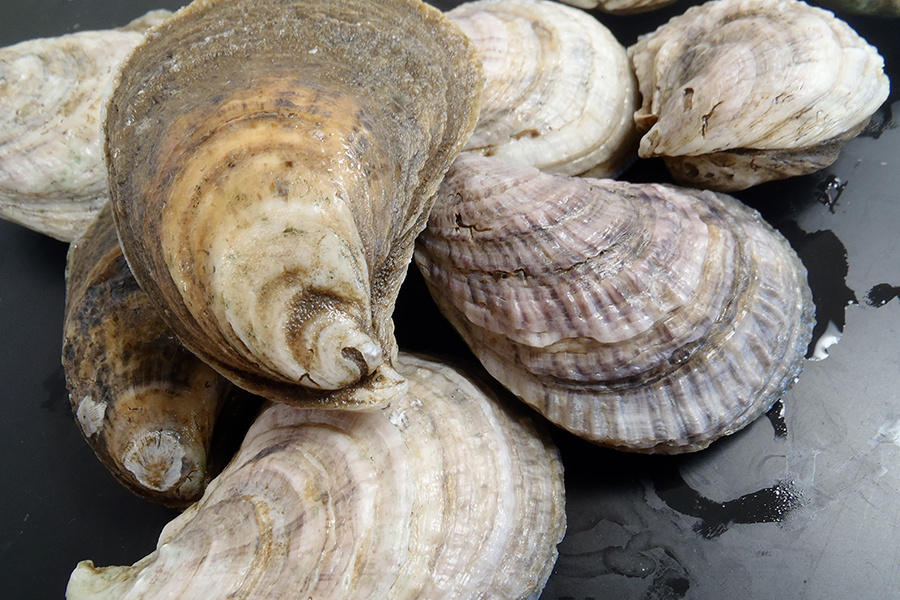
Eastern oysters are bivalve mollusks whose populations have declined due to overharvesting, habitat loss, and changing conditions due to climate change.Massachusetts oysters are closely associated with history and coastal economies, especially as a prized food source, but did you know that oysters provide environmental benefits as well? As a filter-feeder, oysters help to improve water quality and mitigate the effects of climate change.
Saltmarsh Sparrow (Ammodramus caudacutus)
Photo by Liam Wolff
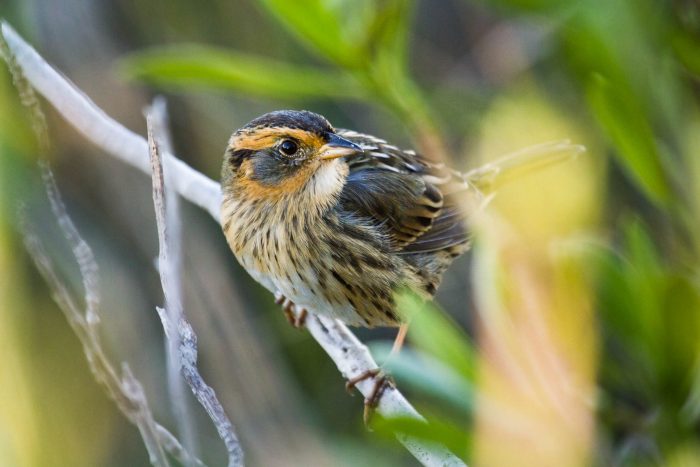
The saltmarsh sparrow is a ground-nesting bird whose population is endemic to the salt marshes of the Atlantic coast. The saltmarsh sparrow only breeds in salt marshes, andas climate change continues to degrade the state of marsh habitats, the population of these sparrows is increasingly vulnerable to climate threats, including sea-level rise and storm events.